
Intergenerational Report 2026 Summary
The Seventh Intergenerational Report IGR was released on 21 September 2026 by our current Treasurer Jim Chalmers.
It projects the outlook for the Australian economy and the Government’s budget to 2065–66. These projections help inform and improve public policy settings to better position Australia for the next 40 years.
This IGR includes a new section on the major transitions shaping Australia’s economy:
- The artificial intelligence revolution
- Geopolitical fragmentation
- Energy transition
- Ageing and the care economy
- Australia’s industrial transformation
As well as a chapter on intergenerational equity.
Date 21 September 2026
ISBN 978-1-923278-63-9
Author Treasury
Topic Economy
Publication type Intergenerational Report
Copyright 2026
The previous Sixth Intergenerational Report was released by Treasurer Jim Chalmers on 24 August 2023 which we summarised here.
The previous Fifth Intergenerational Report was released by Treasurer Josh Frydenberg on 28 June 2021 which we summarised here.
The Intergenerational Report (IGR) Background
The Intergenerational Report (IGR) is a fiscal and economic update that assesses the long‑term sustainability of current government policies.
The Charter of Budget Honesty Act 1998 requires the Australian Government to publicly release and table an IGR at least once every 5 years.
The report looks ahead 40 years. It includes projections for the economy and the government’s budget. These projections help governments understand future challenges and opportunities and support policy decisions.
The first IGR was published in the 2002–03 Budget as Budget Paper No. 5. Intergenerational reports are now published as stand-alone reports.
The 2026 Intergenerational Report: What it signals for school-age numbers
As we have with the last two IGR releases, we went straight to the numbers that matter most for schools and early learning centres:
How many children Australia expects to have, and where?
The headline for educators is sobering. According to the 2026 report, the under-20 population is now projected to grow by only about 10.4 per cent by the early 2060s, whereas the 2023 report expected that same group to grow by almost 28 per cent.
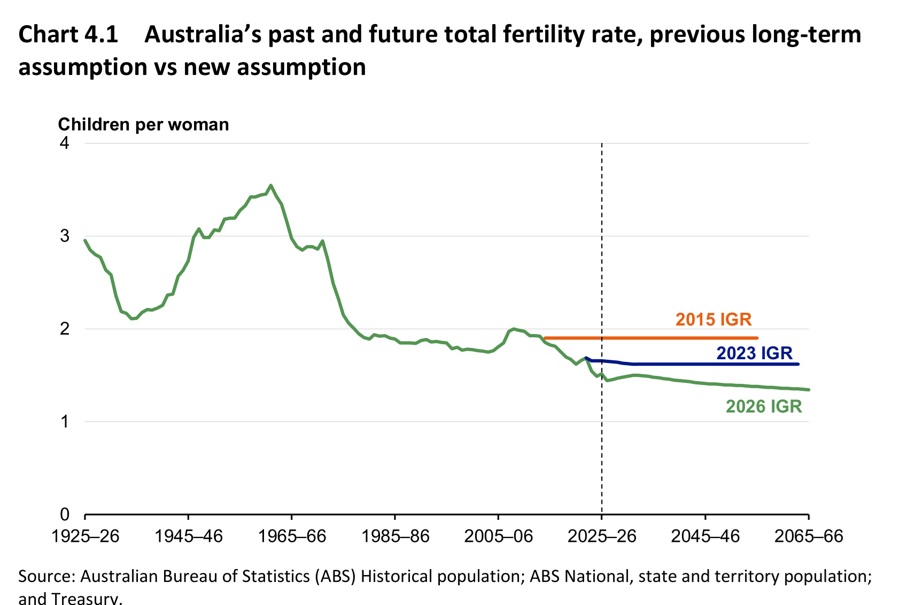
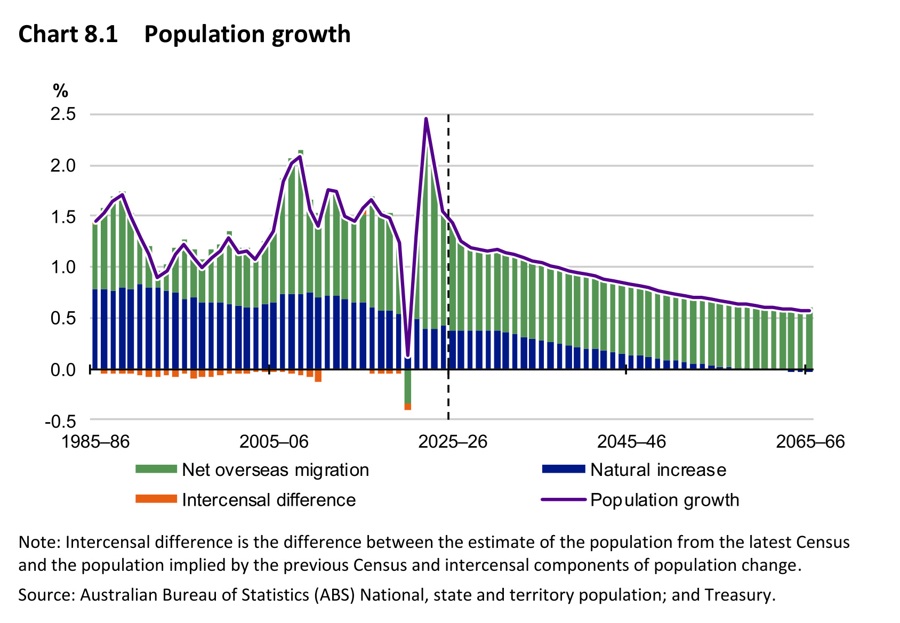
That is a sharp downward revision in less than three years. Behind it sits a lower total fertility rate, cut from the 1.62 assumed in 2023 to 1.34 by 2065-66 (Chart 4.1), together with slower overall population growth averaging about 0.9 per cent a year and, as the report notes, deaths overtaking births in the 2060s for the first time in an IGR.
The total population still climbs, to roughly 39.3 million by 2065-66, but that growth is older and increasingly reliant on overseas migration.
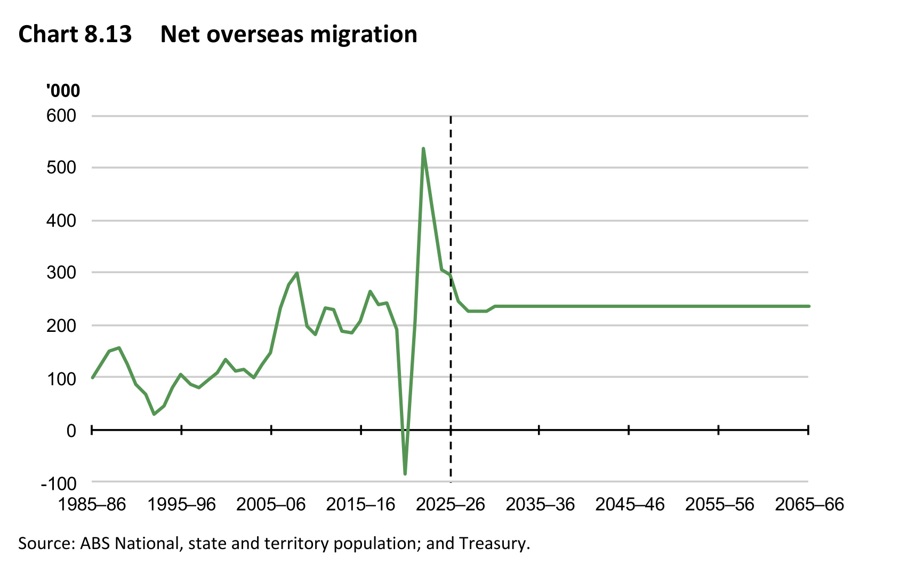
Net overseas migration has already fallen from its 2022-23 peak of 538,000 and is assumed to settle near 225,000 a year from 2027-28, so the modest growth in student numbers that remains rests largely on migration rather than births. The school-age share of the population keeps shrinking.
What does this mean for the next 10 to 20 years?
Nationally, only modest growth in student numbers. Locally, a very different story.
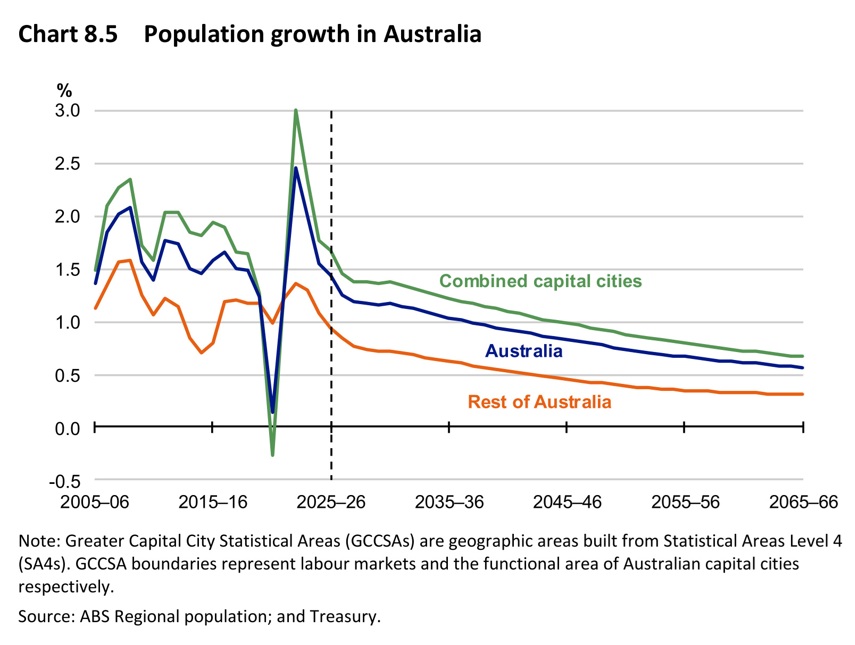
The report projects capital cities to grow more than twice as fast as the rest of the country (Chart 8.5), so new estates will keep filling classrooms while many established suburbs plateau or decline. National averages hide exactly the swings that decide whether a campus or an early learning centre thrives.
This is why catchment-level demographic analysis matters far more than a national headline.
If you would like us to model your enrolment outlook against these new assumptions, we would be glad to help.
Read more about our Education Analysis Services here and Early Years Education Analysis Services here.
You can read the full report on the Treasury website at https://treasury.gov.au/intergenerational-report.